Crypto Hawk
Stop reacting. Start reading.
Two months from now, you stop being someone the market reads — and start being someone who reads the market.
- 8 weeks
- Beginner
- Georgian + English
- 900 PUSDT
You probably know one of these traders.
Tornike
Saw a coin going up on X. Bought at the top because everyone was talking about it. The next day it dropped 20%. He held — "diamond hands." It dropped another 30% the week after. Sold at the bottom. The chart had been screaming "distribution" for two weeks. He didn't know what distribution looked like.
Salome
Opened a 10x leveraged long because a YouTube trader said "this is the bottom." She didn't have a stop-loss because she didn't know what a stop-loss was for. The position liquidated in three hours. The "trader" she copied had moved on to a different prediction by then. She still doesn't know what 10x leverage actually means in terms of her real risk.
Beka
Built a small portfolio in 2021. Up 4x by November. Felt like a genius. Decided he understood the market. Held everything through 2022. Down 80% by June. He had no exit framework. He had no idea support and resistance existed as concepts. He had no journal of his past trades to learn from. So he learned the lesson the market charges the most for: the one paid in real money.
People don't lose money in crypto because the market is unfair. They lose it because they showed up to a chess game without knowing the rules — and treated every move as if it were the right one because they made it. The single biggest predictor of who survives in trading isn't intelligence, capital, or "good calls." It's whether they have a framework, a journal, and the discipline to follow both — even when their emotions scream the opposite. If your trading education came from Twitter threads and Telegram groups, you'll trade like the people who made those threads — and they're not in profit either. Crypto Hawk is the foundation that breaks that cycle.
By the end, you won't recognize the trader you were 2 months ago.
- You stop chasing pumps and panic-selling dumps → You read the chart before you click — and you click less, more profitably.
- You stop guessing what 'support' and 'resistance' are → You draw them yourself, on every chart, before you take a single position.
- You stop reading candlesticks like a stranger reads a foreign alphabet → You read them like a story — and you know what the next chapter is most likely to be.
- You stop trading without a stop-loss → You size every position by your maximum loss — not by how confident you feel.
- You stop forgetting why you took a trade two weeks after you took it → You journal every trade — and read the journal back to find the patterns "your" mistakes leave behind.
- You stop confusing 'I have an opinion' with 'I have a strategy' → You backtest before you bet — and only deploy real money on setups that have already worked on history.
- You stop being someone the market preys on → You become someone the market doesn't break.
8 weeks from now
What B feels like.
It's a Sunday evening. You sit down with your laptop, your trading journal, and a cup of coffee. Six months ago, this evening was different. You'd be refreshing CoinGecko. Reading Telegram chats. Trying to figure out what to buy "before it pumps." Going to bed anxious about Monday's open. Tonight, you're working through your weekly review. You open the journal and read your last 12 trades — what you saw, what you decided, what actually happened. Three of them were wins. Two losses. The other seven were "no-trade" entries: setups you walked away from because they didn't fit your framework. The journal says you walked away correctly five out of seven times. You mark up next week's charts. Bitcoin is testing a level you've drawn three times. You set an alert. You note the conditions that would change your read. You close the laptop. Monday, the alert fires. You take the setup. You set the stop. You let it run. By Friday, the trade has played out — and the journal entry already exists for it. You didn't react this week. You read. That's the difference 8 weeks made.
The 5 disciplines that separate readers from gamblers.
Most people who lose money in crypto don't lack information. They lack discipline — the kind that comes from a small set of frameworks applied consistently over time. The 5 below are the foundation Nika built his own trading on, and the ones he tests live, weekly, on Georgian television. By the end of this course, you don't just know these frameworks. You apply them. To real charts. With real positions (small ones). With a real journal that holds you accountable.
| Framework | What it tells you |
|---|---|
| Chart Anatomy | What candlesticks, volume, and trends are actually saying — before you bring an opinion |
| Support & Resistance | Where the market has agreed on price before — and where it's likely to argue again |
| Risk Management | How much you can lose on one trade without breaking the system that lets you trade tomorrow |
| Trading Journal | What "your" mistakes look like — patterns nobody else's journal can show you |
| Backtesting | Whether your strategy worked on history before you bet your money on the future |
The same frameworks Nika applies live on Georgian TV every week — tested in front of 500+ broadcasts since 2021.
The 8-week journey
From 'the chart confuses me' → fluent in what the market is actually telling you
The crypto market has thousands of assets. The chart shows you what's happening — but only if you know what to look at. This module covers the technical and fundamental tools that separate informed analysis from guesswork: how to study an asset before trading it, how financial and crypto market cycles compare, and the popular tools that extract maximum signal from a chart.
From candlestick illiterate → fluent in the language of price
Japanese candlesticks aren't decoration. They're a language — anatomy, combinations, and the market logic behind them. This module teaches the signs of trend change, the concept of support and resistance, scenario planning with risk hedging built in, and continuation patterns that confirm or deny what came before. By the end, you draw levels on charts the way Nika does on live TV.
From 'I have a hunch' → 'I have a strategy with a defined risk profile'
Trading strategy depends on how long you watch the market. Day, swing, position — each has its own time horizon, its own tools, its own risks. This module teaches risk management, asset diversification across the strategies that suit your personality, and how to protect yourself from market volatility while optimizing profit-taking. After this module, you don't just have an opinion. You have a system that produces opinions you can defend.
From tourist on the platform → operator who knows where to look
Exchanges, trading platforms, news sources — the practical infrastructure that supports informed decisions. This module teaches how to use exchanges and trading platforms safely, how to find and weight reliable information sources, and how to read past market events in the context of current news. The result: you stop trading on rumors and start trading on signal.
This course is for who you want to become as a market participant.
For you
- You want to take your first steps in crypto trading the right way — without learning by losing money first.
- You're an investor who doesn't want to watch charts daily, but wants to make informed buying decisions instead of gut decisions when you do enter a position.
- You've already lost money on Telegram tips and YouTube 'calls' — and you're done.
- You want depth, not slogans. You'd rather hear 'it depends, here's why' than 'buy this now.'
- You're looking for the answer to 'how?' — not 'what?'
Not for you
- You want a course that promises you can trade for a living in 2 months. We won't lie to you. Anyone who promises that is selling you something else.
- You want passive learning. You'll be drawing levels, journaling trades, and backtesting setups every week.
- You're looking for 'the secret strategy' or 'the indicator that prints money.' None of that exists. Discipline does.
- You think a journal and a backtest are optional. They're not. They're the entire point.
Your shortcut.
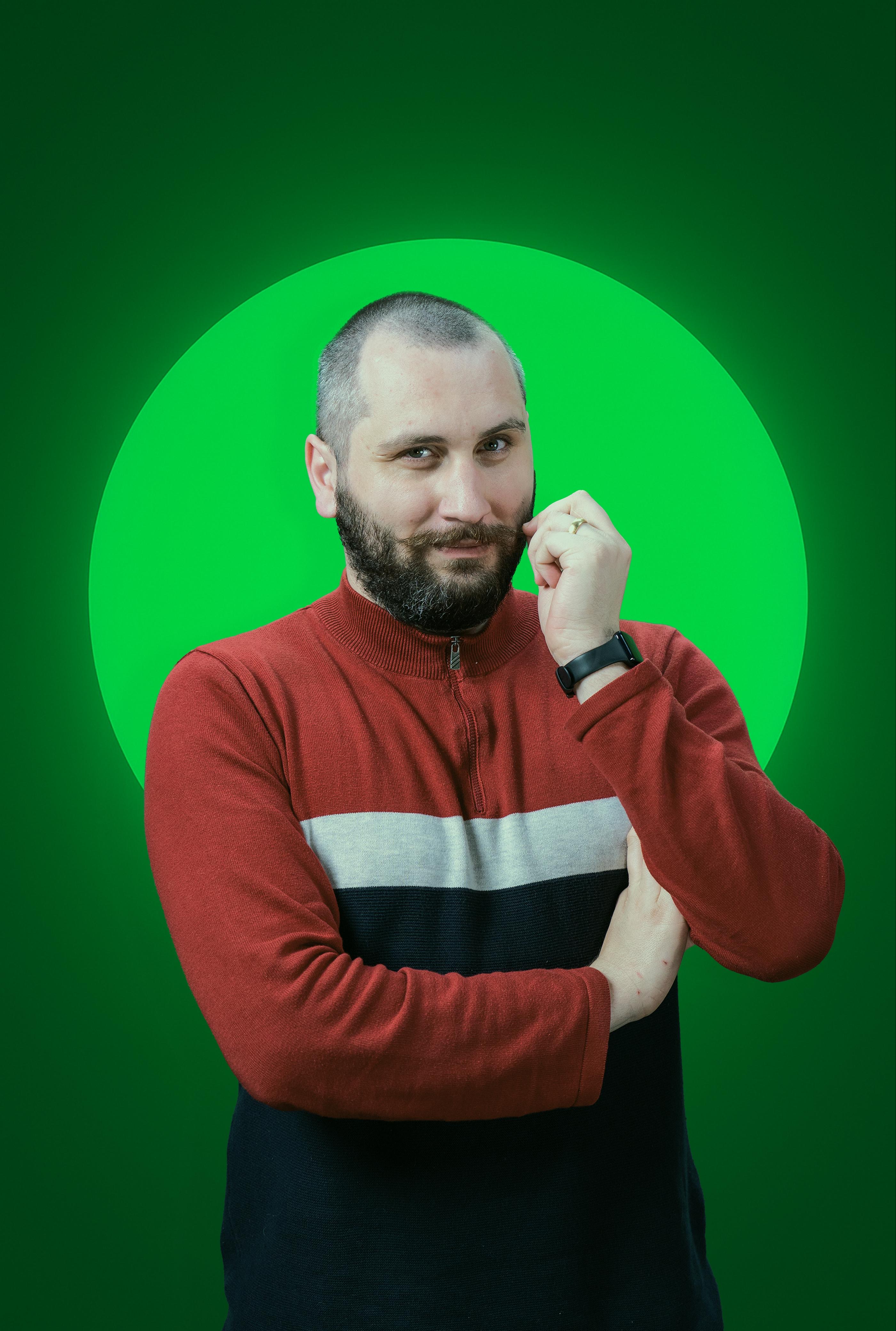
Nika Todua
Co-founder & TV Anchor, Crypto Bazari · Lead Instructor, Crypto Hawk
Co-founder of Crypto Bazari (Georgia's first crypto multimedia platform, 50,000+ community). Live chart analyst on Georgian TV — 500+ broadcasts since 2021. The discipline he teaches is the discipline that survived a four-year live trial.
When you take Crypto Hawk, you skip the years. Years of buying tops because someone famous said to. Years of liquidations on leverage you didn't understand. Years of learning what a stop-loss is *after* you needed one. Years of holding losing positions because you didn't have the discipline — or the journal — to know when to exit. That's the path Nika walked. And it's the unfair advantage you inherit by learning from him. Most online trading instructors edit their YouTube videos. They cut the bad calls. They show you the wins. Nika does live chart analysis on Georgian television. 500+ broadcasts since 2021. Live cameras. Live audience. No edits. Every Bitcoin read, every Ethereum take, every market call he made — recorded, dated, public. The market either confirms a chart read on live TV, or it destroys you in real time. You can't fake that for four years straight. Nika is a co-founder and TV anchor at Crypto Bazari — Georgia's first crypto multimedia platform, with a community of 50,000+. He's a self-developed trader who built his discipline the way this course teaches it: through journaling, backtesting, and unsentimental review of his own past calls. The discipline he teaches is the discipline that survived 500 live broadcasts. When Nika reviews your trade journal, he doesn't just read entries. He sees the patterns "your" emotions leave behind — the same patterns he watched himself fight through, on camera, for years before he won.
Past performance reflects Nika's professional trading and analysis work — not a guarantee of student outcomes. Crypto trading carries substantial risk and most retail traders lose money. This course teaches the foundation, not a path to guaranteed profit.
Designed so you can't fail to develop discipline.
Show up however you can
Tbilisi office or Microsoft Teams — same session, same instructor, your choice. Because the worst reason to miss your foundation is geography.
You journal real trades
Theory doesn't change your trading. The journal does.
Live chart review with someone who's done it on TV
Recorded courses can't tell you why your support level is wrong. Nika can — and he's been telling Georgian audiences why their support levels are wrong every week for over four years. That review is closer to a real trading desk's eyes than anything you'll get on YouTube.
A credential nobody can erase
Other certificates live on a server somebody can shut down. Yours lives on Arweave forever — alongside a journal of dozens of documented trades that prove you didn't just attend, you applied.
Prerequisites
No prior experience required.
Lessons
Coming soonLesson content unlocks once the course launches inside the dashboard.
People often ask
- Yes you will need crypto lion course first of all or basic knowledge of crypto.
- Plan for 5-7 hours per week. That's two 2-hour sessions plus 1-3 hours of practice — drawing levels on charts, journaling your simulated or live trades, and reviewing your own work. Sessions run twice a week for 8 weeks. The journal work is where the real transformation happens. You can attend every lecture and learn very little if you skip the journaling. Don't skip it.
- You can read crypto charts independently. You can identify trends, support and resistance, and the most important candlestick patterns. You can build a simple trading strategy with defined risk per trade. You can keep and review a trading journal. You can backtest a setup before deploying real capital. You can spot the patterns Telegram and YouTube 'gurus' miss. What you cannot do — and we are honest about this — is trade for a living after 8 weeks. Nobody can. What you have is the foundation. The path to professional trading is years of applied work on top of that foundation.
- A laptop or smartphone with internet, a free TradingView account (we use it for charts), and a free account on a major our partner crypto exchanges (for studying the order book and practicing — you do not need to deposit real money to start). For optional live practice, plan for $50-100 you'd be willing to risk on small positions during the course. The course is designed so you can do everything in simulation if you prefer. The journal is your most important tool.
- Pixel Academy is a Patron Member of AmCham Georgia (American Chamber of Commerce), which gives the biggest validation of our company and gives us one of the biggest institutional weight. The certificate itself is issued on Arweave - a permanent, decentralized blockchain. This means the certificate cannot be edited, deleted, or faked, and anyone in the world can verify its authenticity through the Arweave network forever. We're the first academy in Georgia to issue certificates this way. But here's what matters more in trading specifically: alongside the certificate, your trading journal - the documented record of what you did and why - is the actual proof of discipline. Together they're a credential plus a record.
- All sessions are recorded and available to enrolled students for 1 months after course completion. If you miss a live session, you can watch the recording and bring questions to the next live class.
- No course can promise that, and we won't either. Most retail traders lose money - that's an industry-wide statistical reality, not a flaw in any specific course. What Crypto Hawk gives you is the foundation that profitable traders share: chart literacy, risk frameworks, journaling discipline, and backtesting habits. Whether you become profitable depends on what you do "after" this course - how consistently you apply the frameworks, how honestly you review your journal, and how willing you are to take small losses without abandoning the system. We teach you the foundation. The hours of disciplined practice on top of that foundation are yours to put in.
- Crypto Hawk is the foundation: chart reading, support and resistance, basic strategy types, risk management, and journaling. Most students need 6-12 months of applied practice with the foundation before they're ready for the advanced course. The professional trading course (launching after Crypto Hawk graduates have time to apply the basics) goes deeper into algorithmic strategy development, automated tools, advanced position sizing, market microstructure, and the trading psychology of executing under pressure. If you've never traded before, start here. If you've already mastered chart reading and are ready to move toward systematic and automated trading, that's where the advanced course picks up.
Certificate of completion
Coming soonVerified credential
Crypto Hawk
Earn a blockchain-verified certificate stored permanently on Arweave when you finish the course. Certificates are already live on the legacy site; the in-dashboard issue flow launches with the LMS.
The math.
One bad leveraged trade costs more than this entire course. Often more than 10x. One panic-sell at a normal 15% dip — on a ₾20,000 portfolio — costs ₾3,000. The course is ₾2,600 (900 PUSDT). The cost of "not" taking the course is one bad Tuesday. But here's the harder math, the one most courses never make explicit. "The average retail crypto trader loses money." That's not a Crypto Hawk claim — that's the published industry data. The ones who don't lose are the ones with frameworks, journals, and the discipline to follow both. Crypto Hawk isn't a guarantee you'll be profitable. It's the foundation that makes profit *possible*. 900 PUSDT is the price of being on the right side of those statistics from the start, instead of paying tuition to the market in real losses to figure it out. "₾2,600 (900 PUSDT). 8 weeks. The rest of your trading life — built on a foundation, not an opinion."
Two months from now.
Path A
Path A — You're still buying because someone famous tweeted. Still selling because the chart is red and you're scared. Still reading Telegram for 'alpha' that loses you money. Still telling yourself 'I'll do better next time' without changing anything that would actually make next time different. The next bull run comes — and you watch your friends with frameworks make decisions while you make reactions.
Path B
Path B — You sit down on Sunday with your journal. You see what worked, what didn't, and why. You draw your levels for the week. You set your alerts. You set your stops. When the chart moves Monday, you don't react — you check whether the conditions you wrote down match what's happening, and you act according to the plan. You're not chasing the market. You're not predicting it. You're reading it, with the discipline that took the people you used to envy years to build.
Eight weeks separates the two paths. The market doesn't pause while you decide.