Trading Falcon
Stop having opinions. Start running a system.
Eight months from now, you stop being someone who trades — and start being someone who runs the algorithm they built.
- 32 weeks
- Advanced
- Georgian + English
- 21,500 PUSDT
You probably are one of these traders.
Giorgi
Two years of trading. Some big wins. Some big losses. Net result: roughly breakeven. He keeps a journal — sort of. He has indicators on his chart — many of them. He's read books — half of them. What he doesn't have is a single written rule that says "in this condition I enter, with this size, exit at this level." Every trade is improvised. Every loss is a surprise. He calls himself a trader, but he's a chart-watcher with capital.
Mariam
Built a strategy that worked for three months in a bull market. Made 60%. Decided she'd cracked the code. Scaled up the size. The market regime changed. Same strategy, different conditions — drawdown of 45% in six weeks. She had no backtest on a bear market. She had no understanding of what made the strategy work in the first place. She had a streak, not a system. The market took back everything plus more before she figured out the difference.
Levan
Bought a "proven trading bot" online. Plugged it in. The first month it made 8%. The next month it lost 12%. He emailed the seller. The seller said the algorithm "works in the right market conditions." Levan didn't know what those conditions were, because the algorithm wasn't his — he was renting an opinion he couldn't read, couldn't audit, couldn't fix. When it broke, he had nothing. Three months and ₾4,000 later, he closed it down. He still doesn't have a system. He just has a story about why pre-built bots don't work.
People don't fail at trading because they lack opinions. They fail because *opinions are not systems* — and the market only pays for systems.
The single biggest predictor of who succeeds at trading at scale isn't intelligence, capital, or "good calls." It's whether they have an algorithm — written, tested, journaled, owned — that defines exactly what they do in every market condition. And whether they have the discipline to follow it when their gut screams to override.
You can rent a bot from a stranger. You can copy a "proven strategy" from YouTube. You can subscribe to signals from a Telegram group. None of it works for long, because none of it is *yours*. The edge that survives is the one you built and can defend.
Trading Falcon is the course where you build that edge.
By the end, you don't trade like the trader you were 8 months ago.
- You stop having opinions about the market → You have a system that has opinions for you — opinions you've already tested.
- You stop guessing your position size → You calculate it from the algorithm — based on ATR, account size, and your maximum loss per trade.
- You stop entering trades when the chart 'feels' right → You enter when the entry indicator triggers — and not one second before.
- You stop wondering 'is this a good strategy?' → You answer that question with a backtest. With Excel. With numbers — win rate, expectancy, max drawdown, Sharpe ratio.
- You stop letting emotions override your strategy mid-trade → You've built the emotional management discipline — and the rules — that make overriding the system a violation, not an option.
- You stop being limited to crypto → You can apply the same algorithm framework to FX, equities, commodities — anywhere. The principle is the principle.
- You stop being a trader with capital → You become a system designer who happens to deploy capital. **That's the difference between retail and professional.**
8 weeks from now
What B feels like.
It's a Wednesday afternoon. You're in a meeting. Not at your charts. Not refreshing prices. Just doing your work — your other work, the work that pays your real bills, the work that has nothing to do with the market.
Eight months ago, you couldn't do this. You had to be at the screen because you didn't trust yourself to miss a setup, and you didn't trust yourself to react correctly when one appeared. The market owned your attention.
Today, your laptop sits closed. Your algorithm is running. It already knows the entry conditions you wrote into it. It already knows the position size — calculated from ATR and your account balance — that it will take when those conditions trigger. It already knows the stop and the target. It will execute the trade or it won't, by 4:00 PM, while you're in the meeting.
When you check at the end of the day, you see the algorithm took one trade. The journal entry already exists — the system logged it automatically: entry price, size, stop, current status. You read it for thirty seconds. You close the laptop again.
You didn't watch the market today. You didn't react. You didn't override. The system you built worked while you did other work. That's the difference 8 months made.
The 5 components of any algorithm worth running.
Every professional trading algorithm — whether it runs at a hedge fund, a prop desk, or in Tengiz's own account — has the same five components. Beginners try to skip components. Professionals don't. By the end of this course, your algorithm has all five. Properly designed. Tested. Defended. Deployed.
| Framework | What it tells you |
|---|---|
| Entry Indicator | When the algorithm is allowed to take a trade — and not one second before |
| ATR & Asset Measurement | How volatile this asset is right now — and what that means for your size |
| Money Management | How much of your capital is at risk — per trade, per day, per drawdown |
| Position & Exit Management | When to close a winner, when to close a loser, when to do nothing |
| Edge Measurement | Whether your system actually has an advantage — measurable, in numbers |
The same components Tengiz built into the algorithm he's been refining since 2014 — the one he runs his own capital on, across asset classes.
The 8-month journey
From 'I have a strategy' → 'I have a strategy with components I can defend'
A trading strategy isn't a single idea. It's a system of decisions, each one decomposable into rules. This module teaches the architecture: what every professional algorithm has, why each component exists, and how the components interact. By the end, you can read any trading system and identify what it has, what it's missing, and where it will break.
From sizing by feeling → sizing by formula
Position sizing is the single most consequential decision in trading. Get it wrong and the best entry signal in the world won't save you. This module teaches the math: how much capital to risk per trade, how to vary it with volatility, how to scale with account growth, and how to protect against drawdown sequences. By the end, your position size is calculated, not chosen.
From 'I want to trade' → 'I know exactly when to trade and when to do nothing'
Not every market condition is a trading condition. Most are noise. This module teaches you to match strategy frequency to your goals — daily, weekly, monthly — and to your personality, attention budget, and capital. The result: a system that knows when to participate and when to wait. Most retail losses come from over-participation. This module makes that mistake structurally impossible.
From 'I have 8 indicators on my chart' → 'I have the 2 that actually drive my decisions'
Most traders pile indicators on their charts because each one feels like extra confirmation. It isn't — it's noise. This module teaches the rigorous indicator selection routine: the chart, the Excel test, the rating system, the frequency analysis. By the end, your algorithm uses the minimum number of indicators that produce a measurable edge. Anything more is mass — anything less is naked.
From 'I think this works' → 'I can prove this worked, with numbers'
A strategy that hasn't been backtested isn't a strategy — it's a hypothesis. This module teaches the verification mechanisms and pathways: how to test a strategy across years of historical data, how to simulate live conditions, how to identify the metrics that matter (win rate, expectancy, max drawdown, Sharpe ratio), and how to spot the curve-fit traps that kill 90% of 'profitable' backtests. By the end, you don't have an opinion about your system. You have a number.
From textbook crossovers → a crossover system you've actually tested on your asset
The two-moving-average crossover is one of the oldest, most studied entry mechanisms in algorithmic trading. It's also where most retail traders go wrong: they use the textbook parameters (50/200, 9/21) without testing them on their actual asset and timeframe. This module teaches you how to derive the right parameters yourself — and how to know when this entry type fits your overall system, and when it doesn't.
From 'I only know one entry style' → 'I have multiple entry types and know when each one fits'
The zero-line / moving-average crossover is structurally different from the two-MA crossover — it captures momentum shifts the first one misses. This module teaches you the second entry type, when to use it, and how to combine it with the first to create a system that works in more market regimes than either alone. By the end, you understand why a single entry type is a single point of failure — and your system has the resilience that comes from multiple, properly tested entry mechanisms.
From journal as record → journal as performance management system
At Crypto Hawk, you learned to keep a journal. Here, you learn to use it. The trading journal at this level isn't documentation — it's a performance management tool. This module teaches the journaling structure that exposes your emotional patterns, the techniques that let you intervene before the override, and the discipline that converts a tested algorithm into deployed performance. The hardest part of running a system isn't building it. It's not turning it off when it has its first losing month. This module is what makes that possible.
This course is for who you want to become as an operator.
For you
- You're serious about trading — not as a hobby, not as a side hustle, but as a discipline you intend to operate with for decades.
- You have prior trading experience — Crypto Hawk graduate, 1-2 years of self-directed trading, or equivalent — and you've hit the ceiling that opinions and gut feel impose on you.
- You want financial independence built on a system you own, not a salary you receive or a strategy you rent.
- You can do disciplined, routine work — Excel modeling, backtest documentation, journal review — without needing constant novelty.
- You'd rather spend 8 months building a system you'll run for the rest of your life than 8 days searching for a shortcut that doesn't exist.
Not for you
- You haven't traded before. Crypto Hawk is the foundation course. Take that first.
- You want a 'set it and forget it' course where you walk out with a bot somebody else built. We teach you to build your algorithm. Nobody else's.
- You can't commit to 8 months. The deliverable — a tested, deployed algorithm that's actually yours — cannot be compressed.
- You don't want to do Excel work. Most of the testing, optimization, and edge measurement happens in spreadsheets. If that's not for you, this course isn't either.
- You expect ₾7,800/month to buy you guaranteed profits. It doesn't. It buys you the foundation, the framework, and the personal mentorship to build a system. What that system earns is determined by what you do with it after the course ends.
Your shortcut.
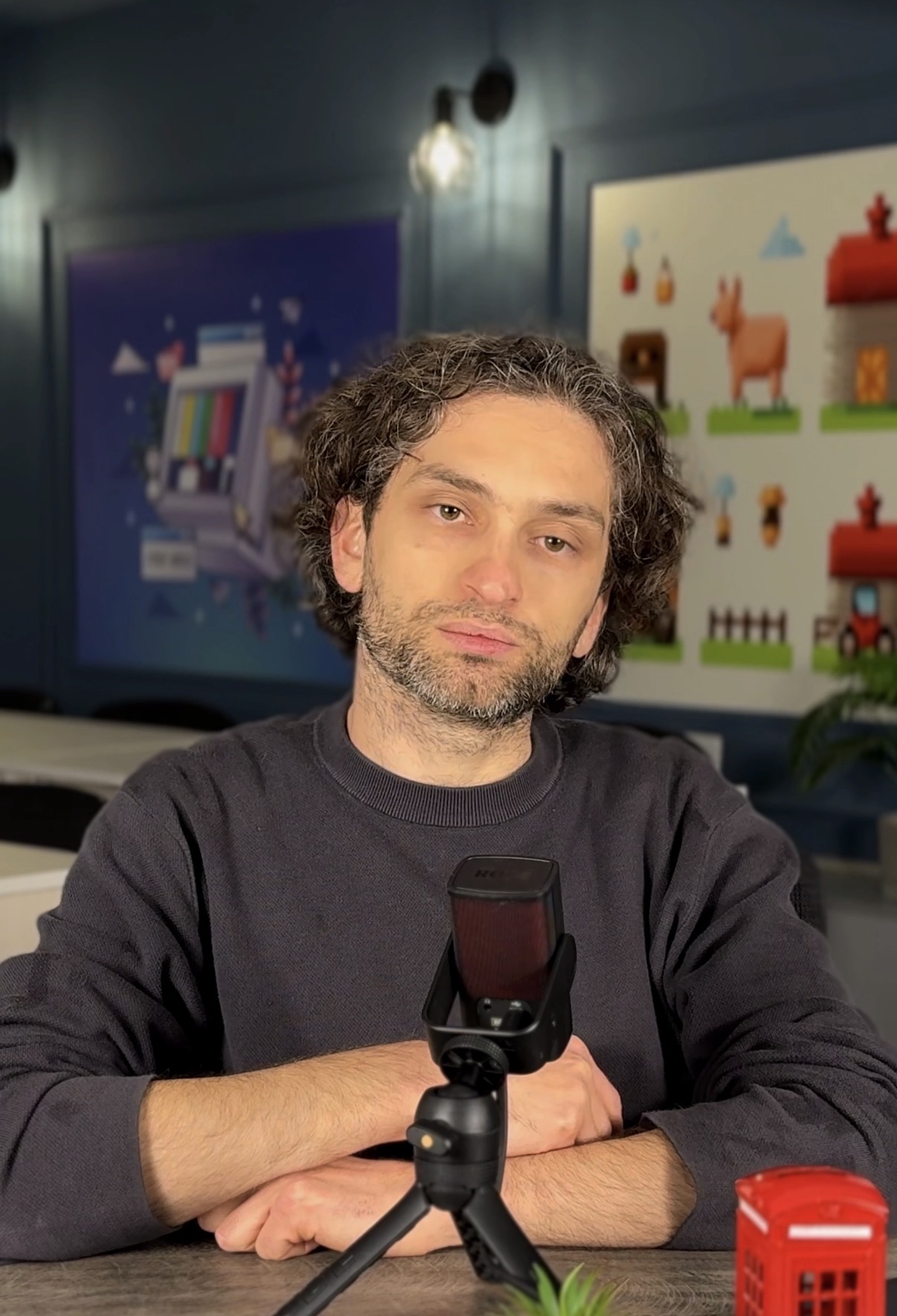
Tengiz Machavariani
CEO, Capital Express MFI · Multi-business Operator · Lead Instructor, Trading Falcon
CEO of Capital Express MFI. Co-Founder of Pepup. Co-Owner of Elektrowerk Ltd. Trading professionally since 2009 — and refining a personal algorithmic system since 2014, across asset classes. The operator's full stack: lending, asset allocation, business ownership, financial consulting.
When you take Trading Falcon, you skip the years.
Years of building strategies that worked once and failed forever. Years of indicators stacked on charts because each one "felt like extra confirmation." Years of journals you wrote and never read back. Years of running a strategy for three months, scaling it up, and watching the next regime change take everything plus more.
But more than that — you skip the years of being a *retail* trader instead of an *operator*. There's a real difference. The operator doesn't trade with opinions. They run a system.
That's the path Tengiz walked. And it's the unfair advantage you inherit by learning from him.
Most "algorithmic trading" courses are taught by academics, YouTube influencers, or crypto-only specialists. Tengiz is none of those things.
He is a working financial executive who's been responsible for real money allocation for nearly two decades:
- CEO of Capital Express MFI since 2020 — running a microfinance institution that lends real money against real risk, where being wrong about credit is measured in jobs lost, not just trades.
- Co-Founder of Pepup since 2022 — a venture he is building from the ground up.
- Co-Owner of Elektrowerk Ltd since 2015 — 11+ years of multi-business ownership.
- Financial Consultant at PLSGE Ltd since 2017 — and previously CFO at PLSGE (2014-2017).
- Former CFO and Deputy Director at Bani Credit — six years inside another microfinance institution, the kind of role where the difference between "good system" and "almost-good system" shows up directly in default rates.
- Former Senior Management Consultant at Asset Management Group (2008-2010) — where his trading career began.
- Briefly Lecturer at the Georgian-European Academy (2011) — early classroom experience.
And in parallel with all of that, since 2009, he has been trading professionally. Since 2014, he's been running an algorithmic system he built himself — one he's refined through more than a decade of live deployment, across asset classes, through bull markets, bear markets, and every regime change in between.
Most trading instructors have a single skill — trading. Tengiz has the operator's full stack: lending, asset allocation, business ownership, financial consulting, and a trading algorithm refined over twelve years on his own capital.
When Tengiz reviews your algorithm draft, he doesn't just check the indicator wiring. He checks whether the logic would survive the kind of risk events that take *businesses* down — because that's the standard he holds his own systems to. The algorithm you build with him is built to that standard. Not the standard of a YouTube tutorial. The standard of a man who's responsible for capital that has consequences.
Past performance reflects Tengiz's professional work and personal trading record — not a guarantee of student outcomes. Algorithmic trading carries substantial risk, and most retail traders lose money. This course teaches the system-building methodology, not a path to guaranteed profit. Whether your algorithm makes money depends on your design choices, your discipline, your capital, and market conditions over which neither the instructor nor Pixel Academy has any control.
Designed so you walk out with a system, not just notes.
Show up however you can
Tbilisi office or Microsoft Teams — same session, same instructor, your choice. Eight months is a serious commitment. Geography shouldn't be the reason it doesn't fit your life.
You build your algorithm
You don't leave with somebody else's system. You leave with your own — written by you, tested by you, refined by you. Tengiz is the architect-mentor. The algorithm is yours, and so is the GitHub-public Excel workbook that documents how you built it.
One-on-one strategy review with an operator who runs his own
Recorded courses can't tell you why your indicator selection is wrong. Tengiz can — and he reviews each student's draft personally. His standard is the standard he holds his own algorithm to: would this logic survive the kind of risk event that takes a business down? If yes, you're ready. If no, you fix it before deployment.
A credential plus a portfolio
Other certificates live on a server somebody can shut down. Yours lives on Arweave forever. Alongside it: your algorithm in a public Excel workbook, your backtest documentation, and a journal of dozens of trades that prove you didn't just attend — you built a system, and ran it. The day a serious capital allocator asks you to prove your discipline, you have the proof.
Prerequisites
No prior experience required.
Lessons
Coming soonLesson content unlocks once the course launches inside the dashboard.
People often ask
- Yes. Trading Falcon is a master course, not a beginner one. You should have completed Crypto Hawk (or have equivalent self-directed experience: at least 12 months of consistent trading with a journal, comfort reading charts, understanding of support and resistance, and at least one strategy you've tried to run with discipline). If you've never traded before, take Crypto Hawk first. The investment is too large and the methodology too dense for someone still learning what a candlestick is.
- Plan for 8-12 hours per week. That's one weekly session (1 hour live with Tengiz) plus 7-11 hours of focused work — Excel modeling, backtesting, documenting your indicator selection, journaling your simulated and live trades, and refining your algorithm based on weekly review. Eight months total. The work is the course. Attending sessions without doing the building work is wasted money.
- You leave with a documented algorithmic trading system you designed yourself: written entry rules, position-sizing formula, exit rules, and edge measurement. You can backtest a strategy on years of historical data and identify whether it has a real edge or just curve-fit history. You can manage capital with risk frameworks that work across asset classes — not just crypto. You can deploy your algorithm and run it with the discipline that distinguishes operators from retail traders. What you cannot do — and we are honest — is be guaranteed profitable. Most retail traders lose money even with systems. The course gives you the foundation a profitable trader needs. Whether you become one depends on what you do after the course ends.
- A laptop running macOS, Windows, or Linux. Microsoft Excel or Google Sheets (most of the work happens here). A free TradingView account. A free account on a major crypto exchange (Binance, Bybit) for live testing — and optionally an account at a broker for FX or equity testing if you want to apply the algorithm beyond crypto. For optional live deployment, plan capital you'd be willing to risk on small positions ($500-2,000 is reasonable for the deployment phase in module 8). Total tooling cost outside the course fee is minimal. The intellectual capital is the investment.
- Pixel Academy is a Patron Member of AmCham Georgia (American Chamber of Commerce), which gives our credentials institutional weight. The certificate is issued on Arweave — a permanent, decentralized blockchain — meaning it cannot be edited, deleted, or faked. But the certificate is the smaller half of what you walk out with. The bigger half: a public Excel workbook documenting your algorithm's design, a public backtest report showing your strategy's measurable edge, and a journal of trades you executed during the course. Together, they're a portfolio that any serious trading desk, prop firm, or capital allocator can audit in minutes. That portfolio is what gets you taken seriously — far more than any certificate alone.
- All sessions are recorded and available for 24 months after enrollment (longer than other courses, because 8 months is a serious commitment and life happens). If you fall behind on the building work, you can join the next cohort's office hours to catch up at no additional cost. If you need to pause for life events, you can pause once for up to 3 months and resume with the next cohort, no extra fee. We don't refund after month 1, because by then you've received the foundational frameworks that constitute the bulk of the value. We do everything possible to make sure you finish what you started.
- Yes — and this is one of the biggest reasons Trading Falcon exists. Tengiz's algorithmic methodology is asset-class agnostic. The components — entry indicators, ATR-based sizing, money management, exit rules, edge measurement — work on FX, equities, commodities, crypto, anything that has a liquid market and a chart. The course uses crypto examples for some demonstrations because of the platform context, but the principles are universal. Many graduates apply their algorithm to multiple markets after completion. The principle is the principle.
- Because what you walk out with is rarer than a course — you walk out with a tested system, designed to your specifications, reviewed personally by a working financial executive who's been refining his own algorithm since 2014. That's not a course. That's a one-on-one mentorship structured as a course. The professional algorithmic trading desks that run systems like the one you'll build don't hire from YouTube. They hire from people who can show a documented system. Most trading-school programs at this depth, in major financial centers, run $15,000-30,000 USD. Trading Falcon, at ₾62,400 (~$23,000), sits inside that range — but with two structural advantages: Tengiz's actual operator track record, and the fact that the deliverable is your system, not a curriculum. If the price feels uncomfortable, take Crypto Hawk first. Trading Falcon is for people who already know the foundation and are ready to commit to the master tier.
Certificate of completion
Coming soonVerified credential
Trading Falcon
Earn a blockchain-verified certificate stored permanently on Arweave when you finish the course. Certificates are already live on the legacy site; the in-dashboard issue flow launches with the LMS.
The math.
Trading Falcon is ₾62,400 over 8 months. Let's be honest about what that buys and what it doesn't.
It does not buy you guaranteed profits. Most retail traders lose money even with systems. We are not selling you a money machine.
What it buys you is the only thing that historically separates the traders who survive at scale from the ones who don't: a tested algorithmic system you designed and own, plus the methodology to keep building and refining systems for the rest of your trading life.
Compare against the alternatives:
— A "proven" trading bot online: ₾100-500/month, lasts 2-3 months, you learn nothing, and when it breaks you have nothing. — Telegram signal groups: ₾50-200/month, indefinite, you remain dependent on someone whose interests are not yours. — A trading school in London or New York with this depth: $15,000-30,000 USD, with less personalization than this course offers. — Your own self-taught trial and error: free in dollars, but typically 3-7 years of net losses before crossing breakeven, if you ever do.
₾62,400 (21,500 PUSDT) is the price of compressing those 3-7 years into 8 months under personal mentorship from a working financial operator — and walking out with a system that's actually *yours*, not rented, not subscribed, not someone else's edge.
₾62,400 (21,500 PUSDT). 8 months. The rest of your trading career — built on a system, not an opinion.
Eight months from now.
Path A
Path A — You're still where you are now. Some wins. Some losses. No system. Still trading on opinions, still adjusting strategy mid-trade, still telling yourself the next bull run will be different. The next bull run comes. You make money for three months. The regime changes. You give it back. Plus more. You've been at this five more years and you're roughly where you started — except now you're also five years older, and the chance to commit to building something real is still in front of you, just smaller.
Path B
Path B — Your laptop sits closed on a Wednesday afternoon while your algorithm runs without you. You designed it. You backtested it. You documented its edge. You journal its trades. When friends ask what you trade, your answer doesn't start with 'I'm watching' — it starts with 'my system runs on these rules, here's the backtest, here's the live record.' You're not a retail trader anymore. You're an operator. Of your own system. **The one you built.**
Eight months separates the two paths. The market doesn't pause while you decide.